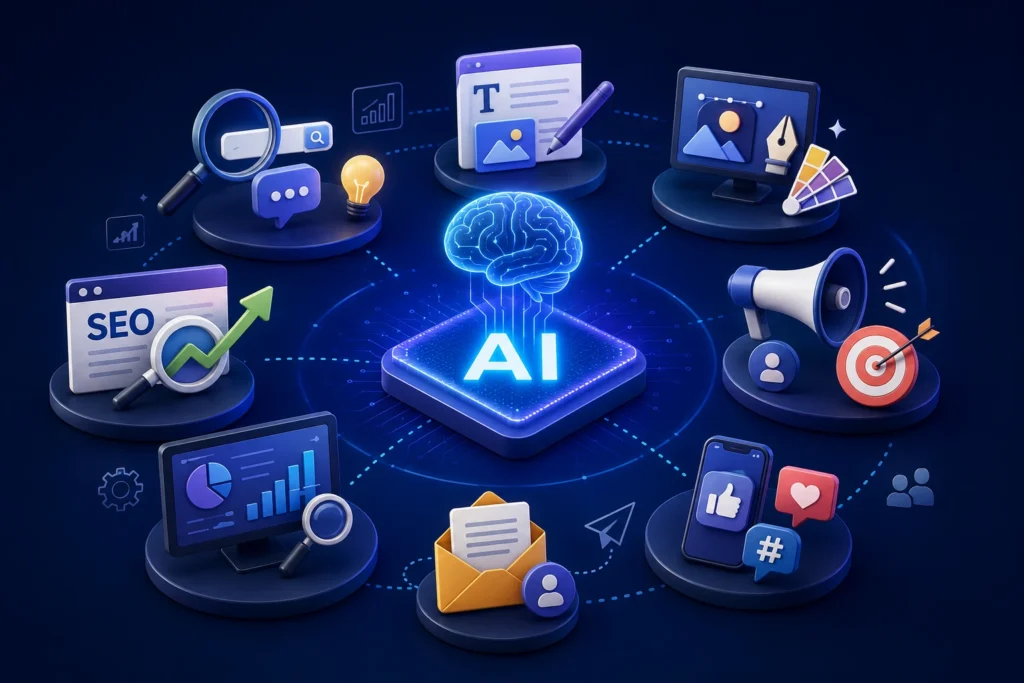
Artificial intelligence is changing how digital marketers work. From content and SEO to design, advertising and analytics, AI can make many marketing tasks faster and more efficient.
But using AI effectively isn’t about learning every new tool.
It’s about knowing what to use, when to use it, and where human judgment still matters.
What Are AI Marketing Tools?
AI marketing tools use artificial intelligence to assist with tasks such as research, content creation, design, data analysis, advertising and automation.
They can save time and provide useful starting points, but they work best as assistants rather than replacements for marketing expertise.
1. AI Assistants for Research and Planning
AI assistants can help marketers brainstorm ideas, create content outlines, summarize information and explore different approaches.
For example, AI can turn a broad topic into potential blog ideas or questions an audience may be searching for.
Best for: Research, brainstorming, planning and first drafts.
However, AI-generated information can contain errors. Important facts, statistics and claims should always be verified using reliable sources.
AI can provide the starting point. The marketer provides the judgment.
2. AI for Content Creation
AI can help with:
-
- Blog outlines
-
- Social media ideas
-
- Headlines
-
- First drafts
-
- Content variations
-
- Content repurposing
But producing content faster doesn’t automatically make it valuable.
Google recommends creating helpful, reliable and people-first content. Its current guidance also explains that generative AI can be useful for research and structure, but creating large amounts of content without adding value can violate Google’s spam policies.
A practical workflow is:
AI draft → Fact-check → Add original insight → Human edit → Publish
This keeps your content marketing focused on usefulness rather than simply producing more content.
3. AI for Design and Visual Content
AI-powered design tools can help marketers create social media graphics, advertisements, presentations and other visual assets more efficiently.
Canva’s 2026 State of Marketing and AI report highlights that AI is increasing creative speed, while direction, personalization and human judgment remain important. The report also points to growing consumer concerns about low-value, generic AI-generated content.
The same principle applies to web design.
AI can help generate ideas, but marketers still need to consider branding, readability, layout and the audience’s needs.
AI can create a visual faster. A marketer decides whether it communicates the right message.
4. AI for SEO
AI can support SEO tasks such as:
-
- Keyword research ideas
-
- Search-intent analysis
-
- Topic research
-
- Content outlines
-
- Meta title ideas
-
- FAQ ideas
However, AI shouldn’t replace actual SEO research.
Google’s latest guidance for generative AI search makes an important point: SEO fundamentals still matter. Google says its AI Search features rely on existing Search ranking and quality systems, so websites should continue focusing on technical SEO and unique, useful content.
Google also advises against focusing on supposed “AEO/GEO hacks” or creating special files and markup solely to appear in AI Search.
So rather than chasing every new AI-search trick, marketers should focus on creating content that is useful, original and trustworthy.
5. AI for Advertising and Performance Marketing
AI is becoming increasingly important in performance marketing.
Google has introduced new AI-powered advertising experiences for the AI era of Search, including conversational ad experiences and AI-powered campaign features.
AI can assist with:
-
- Ad creative
-
- Campaign optimization
-
- Audience targeting
-
- Performance analysis
But marketers still need to answer:
Who are we targeting? What are we offering? Why should they care?
Those are strategic questions that technology alone cannot answer.
6. AI for Social Media and Email Marketing
AI can also make social media marketing and email marketing workflows more efficient.
It can help generate:
-
- Social media ideas
-
- Captions
-
- Content variations
-
- Email subject lines
-
- Email drafts
-
- Campaign ideas
But automated content can easily become repetitive.
Audiences still need content that feels relevant, useful and authentic. AI should help marketers create and test ideas, while humans make the final decisions about tone, messaging and audience fit.
What AI Can Do vs What Marketers Still Need to Do
| AI can help with | Marketers still need to handle |
|---|---|
| Brainstorming | Strategy |
| Drafting | Original ideas |
| Data summaries | Interpretation |
| Content variations | Brand voice |
| Design generation | Creative direction |
| Automation | Quality control |
| Research assistance | Fact-checking |
The goal isn’t to use AI simply because it is available.
The goal is to use it where it genuinely improves the marketing process.
Do Digital Marketers Need to Learn Every AI Tool?
No. New AI tools appear constantly. Trying to learn all of them can become a distraction. Instead, understand the major categories:
AI Assistants → Content → Design → SEO → Advertising → Analytics
Then choose tools based on your actual workflow. Knowing why and when to use a tool is more valuable than simply knowing how many tools exist.
My Practical Take
As a digital marketing professional, I see AI as a support system rather than a replacement for marketing expertise. It can save time, generate ideas and simplify repetitive work. But marketers still need to understand audiences, business goals and context.
Before using AI, ask:
What am I trying to achieve?
Who is this for?
Is the information accurate?
Does it provide real value?
These questions keep AI connected to real marketing objectives.
Final Thoughts
AI is changing digital marketing, but the fundamentals remain:Understand your audience. Set clear goals. Create useful content. Measure results. Use AI where it genuinely helps.The future isn’t necessarily AI versus humans.It is about marketers learning to work effectively with AI while keeping human judgment at the center.
About the Author
Aayisha M S is a Freelance Digital Marketer in Kollam, Kerala, focusing on SEO, social media marketing, content marketing, performance marketing, email marketing and web design. She is interested in practical digital marketing strategies and emerging technologies that can improve online visibility, engagement and growth.
Sources & Further Reading
Frequently Asked Questions ( FAQ )
What are AI tools used for in digital marketing?
AI tools can assist with research, content creation, SEO, design, advertising, social media, email marketing, analytics and automation.
Will AI replace digital marketers?
AI can automate many repetitive tasks, but strategy, creativity, critical thinking and understanding customer needs still require human involvement.
Can AI-generated content rank on Google?
AI-generated content isn’t automatically excluded from Google Search. The important consideration is whether the content provides real value and follows Google’s Search policies. Google specifically says generative AI can be useful when it adds structure or assists with original content, but mass-producing low-value pages can violate its spam policies.
Should beginners learn AI tools?
Yes, but AI should be learned alongside digital marketing fundamentals. Understanding marketing principles makes AI tools much more effective.